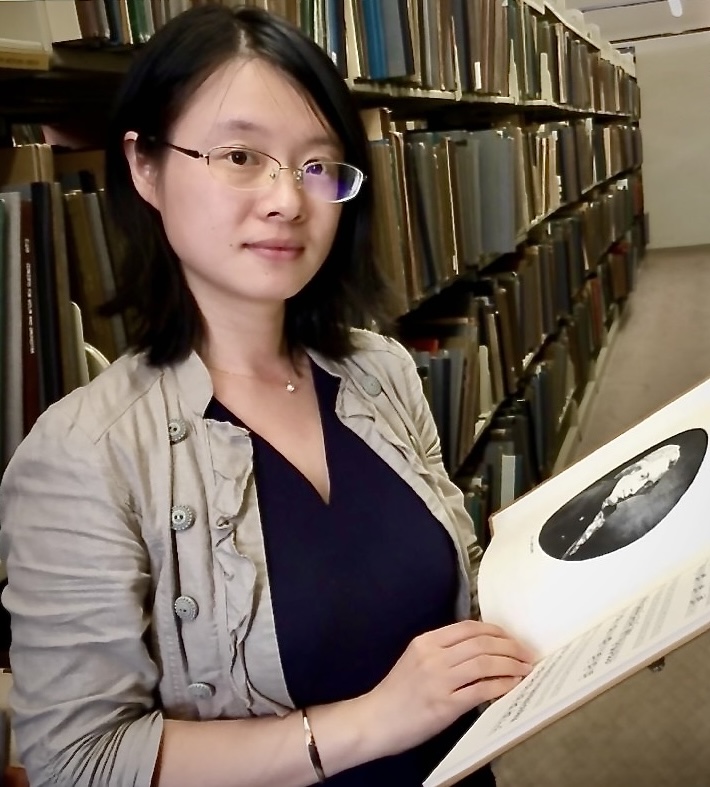
Xu, Nan
Electrical and Computer Engineering
Brain and Behavior Institute
Dr. Nan Xu is an Assistant Professor in the Fischell Department of Bioengineering and the Brain and Behavior Institute at the University of Maryland, College Park, with affliate appointments in the Department of Electrical & Computer Engineering and the Edward and Jennifer St. John Center for Translational Engineering and Medicine, and graduate program affliations in the Neuroscience & Cognitive Science (NACS), Biophysics, and Applied Mathematics & Statistics, and Scientific Computation (AMSC). She leads the Imaging- and Neuro-computations for Precision Informatics Research (INSPIRE) Lab.
Education
- Ph.D., Electrical and Computer Engineering, Cornell University, 2017 - Minors: Applied Mathematics and Cognitive Neuroscience
- B.S., Electrical and Computer Engineering, University of Rochester, 2011
- B.A., Mathematics, University of Rochester, 2011 - Minor: Music
Professional Training
- Postdoctoral Fellow, Biomedical Engineering, Georgia Tech and Emory University, 2019–2024
- Visiting Scientist, McGovern Institute for Brain Research at MIT, 2022
- Postdoctoral Fellow, Chemical and Biomolecular Engineering, Georgia Tech, 2017–2018
Professional Memberships
- Organization for Human Brain Mapping (OHBM)
- Institute of Electrical and Electronics Engineers (IEEE)
- Society for Neuroscience (SfN)
Selected Honors and Awards
- NIH BRAIN Initiative K99/R00 Pathway to Independence Award, 2023
- Sigma Xi Scientific Research Honor Society, 2026
- EMBS Student Paper Competition Finalist, 2016
- “Top 10%” Paper Recognition, IEEE International Conference on Image Processing, 2015
- Goldman Sachs & Co. Scholarship, 2011–2012
- ECE Faculty Award, University of Rochester, 2011
- Phi Beta Kappa, 2011
Our research resides at the intersection of data science and neuroscience. We develop advanced models and innovative data science methodologies to elucidate brain function, neurological disorders, and other biological processes. By leveraging multimodal functional neuroimaging data—including fMRI-BOLD, LFP, optical imaging, and MEG—from animal models, healthy individuals, and patients, we decode complex brain activities and diseases. This integrative approach aims to provide groundbreaking insights that advance both fundamental understanding and translational applications in brain science, informatics, and beyond.
Research Interests
- Computational Neuroimaging & Neuroscience
- Machine Learning and Data Analytics
- Functional Brain Dynamics
Research Methods:
- Computational Modeling
- Statistical & Machine Learning Techniques
- Scientific Computing
- Dynamical Systems and Time Series Analysis
-
Multimodal Functional Neuroimaging
- BIOE689N/NACS728Z: Network Neuroscience and Brain Dynamic Analysis.
- BIOE241: Biocomputational Methods.